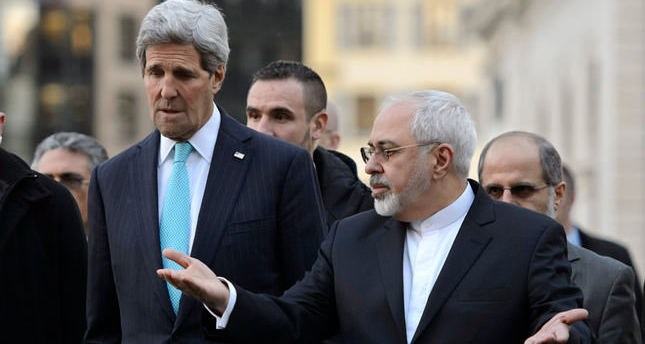
Can a Nuclear Deal Lead to Turkish-Iranian Cooperation on Syria?

This article was originally published in Daily Sabah on February 23, 2015.

Nuclear negotiations between the P5+1 and Iran are currently facing congressional challenges and Israeli obstructionism. If the administration of U.S. President Barack Obama can withstand these pressures and reach a deal that leads to a détente between the U.S. and Iran, it will have implications for the regional balance of power as well as the ongoing conflicts in Syria and Iraq. As Turkey borders both of these countries and has a multitude of strategic and security interests regarding the nuclear negotiations, Turkish foreign policy will be impacted by Iran’s approach to Iraq and especially Syria.

Turkey has had a simultaneously competitive and cooperative relationship with Iran. For the past several years, Turkey and Iran have compartmentalized their disagreement over Syria for the sake of mutual energy interests. A potential nuclear deal could benefit Turkey through the reduction of regional tensions as well as increased bilateral trade. However, the Turkish-Iranian disagreement over Syria will not be easily overcome even if a deal is reached because Iran is unlikely to shy away from its regional ambitions as a result. If anything, a détente might embolden Iran in knowing that it will not be threatened militarily by the United States. At the same time, Iran may modify its threat perception and rethink its regional foreign policy posture in order to reduce the cost of investing in the regime of Syrian President Bashar Assad. If the latter becomes the case, Iran and Turkey may be able to reduce their differences over Syria, contributing to stability in the region in the long run.

The reaction of regional actors toward a potential deal will have a bearing on the actual benefits. Saudi Arabia will be unhappy as it sees itself in an existential struggle to counter Iran throughout the region. Only an Iranian effort to reach out to Saudi Arabia and change its policy in Syria and Iraq would ease the Saudis’ concerns, albeit to a limited extent. If the Saudi fears about Iran linger and Tehran does nothing to alleviate them in concrete terms, a nuclear deal may simply deepen their insecurity, as they would feel abandoned by the U.S. Continued Saudi-Iranian confrontation in the region would only worsen the prospects for a solution in Iraq and Syria.

Israel’s reaction to a potential deal will predictably be based on a “no deal is better than a bad deal” framework. Israeli Prime Minister Benjamin Netanyahu has been pressuring the Obama administration to demand harsher terms in the negotiations, and he will almost certainly oppose any kind of deal that allows Iran to retain its nuclear enrichment capabilities. The Obama administration has been pushing back against Israeli criticism by calling Netanyahu names in a not-so-diplomatic way, which also speaks to the administration’s anxiety about the potential for failure. It remains uncertain whether the deal will be acceptable to the newly Republican-dominated U.S. Congress or to Iranian Supreme Leader Ali Khamenei. Nevertheless, Israeli discontent over a possible deal will only add to regional tensions.

In addition to bolstering Obama’s non-proliferation agenda, a potential deal will have implications for Iran’s standing in the region. In 2010, Turkey, as a non-permanent member of the U.N. Security Council at the time, tried to help forge an agreement between the P5+1 and Iran. The Tehran Declaration was meant to be a confidence-building measure, but it was dismissed by the West based on the view that the agreement was part of an Iranian ploy to duck the impending sanctions resolution. Turkey’s efforts in 2010 were driven by its desire to engage with Iran and help integrate it into the international system. Its insistence on diplomacy as opposed to sanctions was motivated by Turkey’s interest in reducing regional tensions to allow for a stable and peaceful environment to pursue its business interests. These interests remain unchanged today and they can be the primary driver of cooperation with Iran.

Potential for cooperation, however, does not mean that Turkey and Iran will not compete for influence in the region. The Syrian conflict has proven to be a major sticking point in the Turkish-Iranian relationship. Iran continues to back the Syrian regime, and its support of its most important regional ally, Hezbollah, has been critical for Assad’s survival. President Recep Tayyip Erdoğan lamented recently that an understanding with Iran and Russia over Syria is critical for a political deal but has so far proved impossible. While a nuclear deal could initiate a conversation on Syria, it will not provide a resolution for the conflict, as Iran remains committed to the regime, which Turkey sees as the source of the problem.

There is an incentive for Iran and Turkey to cooperate on Syria, as both countries are faced with a huge burden from the fallout from the conflict. If they can identify issues they agree on, they can work toward an eventual resolution. One such agreement could be on the need to counter the Islamic State of Iraq and al-Sham (ISIS), though Turkey would place equal emphasis on the need for Assad’s departure. If Tehran were to agree on a political transition in Damascus, Turkey might be more amenable to cooperation with Iran against ISIS. This conversation would have to be extended to Iraq, where Iran can help Baghdad in drawing Sunni groups into the political system.

Turkey has shown time and again its ability to work with all political actors in the region. Despite the deep and arguably irreconcilable differences between Iran and Turkey on a variety of regional issues, the countries remain major players that can contribute to the resolution of the Syrian conflict and Iraq’s stability. For that to happen, Iran will need to move away from its narrow calculations about how to gain from the current conflicts in Iraq and Syria and instead adopt a more strategic, long-term vision for the region. Otherwise, Iran will find itself further apart from Turkey, engaged more in competition than cooperation.

For its part, Turkey needs to continue its efforts to find common ground with Iran over Syria. Although Iran seems bent on supporting Assad, Damascus has proven to be a heavy burden for Tehran. As a result, Iran has an incentive to stabilize Syria, though it will likely be maximalist in its demands in furthering its interests, such as keeping key regime figures in place during a potential transition and ensuring Hezbollah’s standing in Syria. A nuclear deal may help speed the opening of the Iranian economy to the outside world and improve Turkey’s economic ties and bilateral trade deficit with Iran if sanctions are lifted. The two sides may be able to build on improved economic relations in order to discuss regional political issues in a new light. There is no magic bullet for solving the Syrian and Iraqi crises, but a common understanding between Ankara and Tehran would go a long way in contributing to a solution.

Overcoming US-Turkey differences on Syria

This analysis was published by Daily Sabah on October 29, 2014.

Ever since President Obama announced that the U.S. would “degrade and ultimately destroy ISIS,” American policymakers have been scrambling to put together an effective alliance. The U.S., with help from its Gulf allies, has conducted hundreds of airstrikes, but the results have been less than impressive. The U.S. has ruled out “boots on the ground,” and no outside power has been willing to send soldiers. Though the U.S. is banking on the Baghdad government and Iraqi Kurdistan Regional Government (KRG) President Masoud Barzani’s forces to take the fight to the Islamic State of Iraq and al-Sham (ISIS), both of these forces currently remain focused on protecting their own territory. Moreover, the success of the plan to create a Sunni national guard in Iraq is far from certain. Training and arming the Syrian opposition remains a long-term endeavor with little promise of immediate results.

Ankara expressed a willingness to provide ground troops, however, only if the U.S. and its coalition partners agreed to create safe zones protected by a no-fly zone with a political objective to push for a transition in Damascus. There are stark differences between the U.S. and Turkey about how to approach this threat because the U.S. continues to define its objective narrowly as targeting ISIS. In contrast, Ankara advocates for a broader strategy to address the Syrian civil war as a whole. The fighting in Kobani has only underscored the differences in these two approaches.

The Obama administration’s Syria policy has oscillated between an earlier commitments to regime change to near dismissiveness about getting involved in “someone else’s civil war.” The U.S. has found no significant interest to justify intervention in Syria, despite continual warnings that the situation would simply get worse. In the wake of Syrian President Bashar Assad’s repeated chemical weapons attacks on civilians, the Obama administration settled for the Russian-brokered deal. Left to its own devices, the Assad regime has felt free to continue its killings – more than 200,000 deaths by the most modest calculations – use of chemical weapons and support of terrorist groups. Turkey’s view is that the Assad regime is directly responsible for the growth of ISIS as it facilitated the group’s advances to counterbalance the Syrian opposition. In contrast, the U.S. refuses to confront the Assad regime in a serious way, arguing that there is no viable alternative and that the collapse of the regime would lead to further instability. With the fall of Mosul to ISIS in Iraq, the Obama administration was faced with the collapse of its Iraq policy, which had already been criticized for not including a residual U.S. force. The U.S. is now being pulled back into Iraq with the Baghdad government and KRG requesting help. Moreover, American public opinion shifted quickly toward taking action in the wake of ISIS’s brutal beheadings of American journalists. Under domestic pressure and the real danger that the Iraqi state could collapse, President Obama announced a counterterrorism strategy that was more reactionary than well developed.

The problem reaches far deeper than the emergence of yet another terrorist organization. There is an overwhelming feeling of disenchantment among Sunnis, which ISIS cynically tapped into and manipulated. In the context of Iraqi politics, the removal of Nouri al-Maliki as prime minister was a positive step that addressed certain Sunni grievances, but it might prove to be too little too late. By neglecting the Syrian civil war and Maliki’s sectarian policies for so long, the U.S. and the broader international community are at least partly responsible for the emergence of ISIS. If the U.S. fails to address the conditions that created ISIS in the first place, its anti-ISIS strategy will be ineffective and U.S.-Turkey cooperation will be hampered. While the U.S. remains unwilling to expand its mission beyond the goal of defeating ISIS, Turkey feels that limiting the mission to ISIS alone will only provide a short-term solution at best and will likely serve to benefit Assad in the long run. Turkey does not want Kobani to fall to ISIS as Ankara decided to allow KRG peshmerga forces to cross into Kobani through Turkish territory, but Turkey’s position is complicated by the fact that the PKK-linked Democratic Union Party (PYD) is fighting against ISIS. The PKK remains a threat for Turkey, as it has not withdrawn from the country and has conducted fresh attacks on Turkish security forces. As Prime Minister Davutoglu said, if the PKK had already withdrawn from Turkish soil and avoided threatening Turkey, Ankara’s approach to the PYD may have been different today. Given that Turkey feels it is faced with two bad choices – helping the PKK gain ground in Syria or ISIS controlling Kobani – the U.S. needs to avoid alienating Turkey through unilateral moves such as helping the PYD against Turkish advice.

Encounter – Voice of America: “Turkey, Kurds and ISIL”

SETA Foundation at Washington, DC Research Director Kadir Ustun Joined Encounter – Voice of America to discuss “Turkey, Kurds and ISIL”

Denise Natali, Senior Research Fellow at the Institute for National Strategic Studies at the National Defense University, and Kadir Ustun, Research Director at the SETA Foundation, demystify the controversy surrounding Turkey’s role in the US-led coalition to fight ISIL with host Carol Castiel.

Listen to discussion

Rudaw Discussion: “Will Kobane Be Saved?”

SETA Foundation at Washington, DC Research Director Kadir Ustun Joined Rudaw to discuss “Will Kobane Be Saved?”

Washington D.C. – This week,  Kobane has been at the center of discussions here in the US capital. Military generals have warned the US airstrikes will not prevent the Kurdish city from falling to the Islamic State militants.

Turkish Prime Minister Ahmet Davutoglo has said his country will not allow Kobani to fall. But so far Turkey has done literally nothing to stop the advance of the militants on the border city. A large number of Turkish tanks have been brought to the border, from which you can see the city and smoke rising from its outskirts.

Meanwhile, U.S. Secretary of State John Kerry has said saving Kobani is not a strategic objective of the United States. What about Turkey? Isn’t there anything at stake for Turkey should this Kurdish city fall and a possible massacre ensure? We have already seen large protests in Turkish cities, where the police have shot dead more than a dozen protesters.

Today we will discuss the possible impacts of the fall of Kobani on Turkish domestic politics and particularly on the fragile peace process with the pro-Kurdish rebels of the Kurdistan Workers Party- better known as the PKK.

Key guests:
– Marina Ottaway, a renowned scholar and expert in Kurdish affairs at the Wilson Center.
– Tolga Tannis, a Turkish journalist in Washington DC.
– Joshua Walker, a senior fellow at the Truman Project specializing in Turkish and Kurdish affairs.
– Kadir Ustun, Research Director at the SETA Foundation at Washington.

Watch Video

Amerika’nın IŞİD’le imtihanı

Bu analiz 12 Ekim 2014 tarihinde Star Açık Görüş‘te yayınlanmıştır.

Bu günlerde Washington’da ne oldu da (Obama Suriye’de olan bitene üç yıldır ciddi bir tepki göstermezken, Irak’ta Maliki’ye baskı yapmaktan uzak dururken) birden bire IŞİD’a karşı askeri tedbirler alma gereği duydu sorusuna ikna edici bir yanıt bulmak kolay değil.

Obama yönetiminin uzun zamandır Ortadoğu’da Amerika’nın maliyetlerini ve risklerini azaltmaya çalıştığını biliyoruz. Suriye’de 200 bini aşkın ölü ve milyonlarca mülteci yeni yüzyılın en büyük insani trajedisini ortaya çıkardı. Suriye’deki iç savaş bölgede birçok dengeyi alt üst etmekle kalmadı, Sünni-Şii gerginliğini çatışma ve ölüm-kalım savaşına dönüştürmede katalizör görevi görerek belki de on yıllarca üstünden gelinemeyecek bir şekilde derinleştirdi. El-Kaide bağlantılı grupların güçlenmesi ve Esad rejimiyle savaşmaktansa kendilerine ait bölgeleri kontrol etmeye çalışmaları bile Amerika’yı harekete geçirememişti. IŞİD’in Musul’u ele geçirmesi ve Bağdat’a doğru ilerlemesi Obama’nın Irak’tan çekilme politikasının iflas etmesi sinyalleri verince yönetim meseleye daha ciddi yaklaşma gereği duydu.

Amerikalı gazetecilerin kameralar önünde katledilmesi bardağı taşırdı ve Amerikan kamuoyunun Irak’ta teröristlere karşı askeri harekata desteğini artırdı. Irak politikasının iflasının ilanı Obama için kaldırılabilir bir siyasi maliyet değildi. Continue reading Amerika’nın IŞİD’le imtihanı

Coalition’s Half-baked ISIL Strategy Won’t Work

This article was originally published in Al Jazeera on October 9, 2014.

The US aerial campaign against ISIL around Kobane has intensified in the past few days. There are reports from Kurdish sources on the ground that the strikes are helping to some extent. The US strategy, so far, has entailed strikes against ISIL positions in Iraq to be supported by ground forces supplied by Baghdad and the Kurdistan Regional Government (KRG). While this strategy seems to have stemmed the advance of ISIL in Iraq to a certain degree, it is proving less effective and potentially counterproductive for the humanitarian situation in Syria.

Compared to Iraq, there is very little ground support in Syria to back the US military aerial efforts. Training and arming the moderate Syrian opposition to curb ISIL’s advances and produce effective results will take time. Unless it targets the regime, the coalition will not be able to enlist the full support of the moderate opposition forces to engage ISIL on the ground. Already, the Syrian opposition groups have criticised the strikes, as they are not directed against the Assad regime. Even while they are willing to fight ISIL, they want the coalition to also take on the Syrian regime. Their position is that if Assad is not dealt a blow, the coalition’s efforts to destroy ISIL will prove to be futile and strengthen the regime instead. As the US strategy involves no “boots on the ground” and intends to rely on opposition forces for the ground operations, it can only bring them into the fold by addressing their concerns and aligning priorities.

The rise of ISIL was borne out of the Sunni insurgency in Iraq and the vacuum created by the Syrian civil war. The Assad regime left ungoverned spaces for extremist groups to take hold. Civilians were forced to bend and bow or break under their rule. The emerging danger shows that the coalition has failed, thus far, to devise a political strategy to address the plight of the millions of displaced civilians caught between the brutal Assad regime and violent militant groups, such as ISIL.

Narrow approach

The current strategy employs a narrow counterterrorism approach and avoids the difficult task of engineering a transition in Syria and convincing Sunnis in Iraq to disavow ISIL. For the air strikes to succeed, they need to be supported by the Syrian opposition and Turkey – both have promised to put boots on the ground if the Assad regime is targeted.

Although the US has attacked ISIL positions, the campaign needs to be far more robust and sweeping beyond air strikes. If not, ISIL will survive, reorganise, increase its internal cohesion, and expand its external appeal.

ISIL has moved against the more vulnerable region of Kobane in Syria, as it accurately realised that the US was more concerned with ISIL’s presence in Iraq. The western powers, such as the UK and France, said they would only conduct operations in Iraq for the time being, which encourages ISIL to extend its reach into Syria.

This approach indicates a lack of commitment to countering ISIL in Syria and encourages ISIL to focus its operations there. The coalition’s half-measured aerial military attacks not supported by ground forces will fall woefully short of the intended goal to “degrade and destroy ISIL”.

In a matter of days, ISIL’s advance towards Kobane resulted in the flow of close to 180,000 Kurdish refugees into Turkey. Kurdish civilians have had to either flee the town, become refugees in Turkey or risk getting caught up in the middle of a street-to-street battle between the Democratic Union Party’s (PYD) armed wing People’s Protection Units (YPG) and ISIL.

Pressure on civilians

Since the beginning of the civil war, the international community has failed to protect civilian populations in Syria – Kobane is only the latest example. Establishment of a safe zone by the coalition forces can stem the influx of refugees and protect civilians. While ISIL’s advances need to be rolled back militarily, the pressure on civilians has to be addressed. Otherwise, ISIL will find more breeding ground among civilian populations who feel desperate and abandoned by the international community. Part of ISIL’s success has depended on its ability to take advantage of the plight of civilians. If the strikes are not combined with a comprehensive plan to address this fact, they will inadvertently help ISIL.

The PYD has promoted itself as the protector of Kurdish civilians but their demands for autonomy in Syria and “de facto alliance” with the Assad regime has earned them distrust among the Syrian opposition and in Turkey. The PYD has recently signalled that they might drop their opposition to the safe zone idea and finally agree to the establishment of a safe zone if it is done by an international coalition. If the US agrees to broaden the mission, Turkey will be willing to be part of a coalition effort to protect civilians by creating a safe zone and a no fly zone. In the absence of such a commitment, Turkey’s posture will remain defensive, in which case the US strikes will achieve very little in the way of protecting civilians.

The current US strategy restricts itself to counterterrorism measures, and thus fails to address the Sunni insurgency in Iraq and the civil war in Syria, which facilitated ISIL’s rise in the first place. It also seems to ignore the degree to which the Assad regime fuelled the rise of ISIL to prove that the regime was in a fight against terrorists.

ISIL has been instrumental to the success of the divide and rule tactics of the Assad regime against the moderate opposition. Air strikes alone are not enough to stop ISIL and they will likely create more refugees and produce civilian casualties. If the US bombs and walks away instead of committing to a broader longer term strategy of political transition in Syria, the conditions that strengthen ISIL will not change. In that case, the Syrian humanitarian crisis will only deepen and devolve into catastrophe.

Kadir Ustun is the Research Director at the SETA Foundation at Washington, DC. He also serves as an Assistant Editor of Insight Turkey, an academic journal published by the SETA Foundation.

The views expressed in this article are the author’s own and do not necessarily reflect Al Jazeera’s editorial policy.