Category Archives: Foreign Policy

Can Manbij serve as a Model for US-Turkey Cooperation in Syria?

This article was first published by New Turkey on March 27, 2018.

If the U.S. and Turkey can work together in northern Syria, they could broaden their regional strategic conversation that might also include Iran in the near future. A cooperation in Syria between two NATO allies is not a wishful thinking; it is a matter of will whether they will.

Can Manbij serve as a Model for US-Turkey Cooperation in

The U.S. and Turkey have been pursuing conflicting strategies in northern Syria for a while now. Turkey adamantly pursued to end the U.S. support for the YPG while the Trump administration has seen the group as its “local partner” in the coalition’s anti-Daesh efforts. Turkey’s Operation Olive Branch has recently ended the YPG’s control over Afrin, a city in which the U.S. has declared no interest but expressed “concern” about the Turkish operation. While Turkey is focused on clearing its borders from the YPG and Daesh, the U.S. is insisting that Turkish military operations distract from the fight against Daesh.

The strategies of the two countries diverge from one another so much that they carry the potential to come head to head in Manbij. However, negotiations in bilateral strategy talks, a mechanism established following the former National Security Advisor H.R. McMaster and Secretary of State Tillerson’s visits to Turkey, could yield a cooperation deal in Manbij, which could potentially be broadened. In such an optimistic scenario, the anti-Daesh fight would actually be strengthened while Turkey’s security concerns vis-à-vis the YPG could be met. A deal that pushes the YPG back east across the Euphrates and establishes a U.S.-Turkey coordinated patrol of Manbij can be the basis of broadened cooperation in northern Syria.

Today, Turkey is pushing the U.S. to end the YPG control in Manbij, a promise made by Vice President Joe Biden under the Obama administration. The capture of the town was so alarming that Turkey launched Operation Euphrates Shield in August 2016, only a month after the failed coup attempt of July 2016, in order to prevent further spread of the YPG control in the area. For Turkey, the PKK was trying to accomplish what it could not inside Turkey by creating an autonomous zone in northern Syria through the YPG. By intervening for the first time militarily in Syria, Turkey took the matter into its own hands as multiple U.S. reassurances about the short-term and tactical nature of its support for the YPG did not materialize.

Turkey has been able to change the strategic environment on the ground through its military operations at the expense of both the YPG and Daesh. Clearing its border from both terrorist organizations seems to be its current strategy. The U.S. strategy only partially overlaps with the Turkish strategy but that could be considered as a glass half full. Through an arrangement as described above, diversification of the governing structure of Manbij more representative of the ethnic makeup of the area could be accomplished. U.S.-Turkey military cooperation in patrolling the city can be a trust building measure. Such success in Manbij would not erase the overall strategic differences between the two allies but it would pave way for a broader and meaningful strategic conversation.

The U.S.-Turkey strategic realignment will be very difficult to achieve as the U.S. keeps its exclusive focus on Daesh while ignoring Turkey’s legitimate security concerns regarding the YPG. However, if Manbij can serve as a success story of military and political cooperation on the ground, both Ankara and Washington can build upon it. Regular strategic conversations to coordinate policy are a must between the American and Turkish governments and it can start with Manbij. This is true not only for their Syria policies but other regional issues as well.

As the Trump administration is gearing up to pull the U.S. out of the Iran nuclear deal, a new era of uncertainty and tensions will likely emerge. President Trump has championed “America first,” a slogan that at times manifested itself as unilateralism in foreign policy. The recent addition of the Pompeo-Bolton duo to the administration promises more unilateralism than multilateralism. The administration will likely find an unwilling Europe to corner Iran, and Turkey is not likely to take a confrontational stand against Iran. Yet, if the U.S. and Turkey can work together in northern Syria, they could broaden their regional strategic conversation that might also include Iran in the near future. A cooperation in Syria between two NATO allies is not a wishful thinking; it is a matter of whether they will.

Is Pompeo the Right Man for a Trumpian Foreign Policy?

This article was first published by New Turkey on March 20, 2018.

Between his campaign promises and disdain for Obama’s foreign policy, Trump is not ready to settle for approaches favored by the “adults” in his administration. Tillerson for him was not the right man for the job of devising a Trumpian foreign policy.

Is Pompeo the Right Man for a Trumpian Foreign Policy

President Trump’s dismissal of Rex Tillerson via a Twitter message together with the appointment of Mike Pompeo to head of the State Department has raised many questions about the future course of U.S. foreign policy. So far, the Trump administration has not exactly put its stamp on foreign policy and continued the Obama administration’s policies, perhaps with less micromanagement and more authority to the “generals.” Between his campaign promises and disdain for Obama’s foreign policy, Trump is not ready to settle for approaches favored by the “adults” in his administration. Tillerson for him was not the right man for the job of devising a Trumpian foreign policy.

In the anti-Daesh coalition efforts, the administration allowed CENTCOM to take the lead and continued the policy of allying with “local partners” (YPG) to defeat Daesh, resulting in tensions with NATO ally Turkey. Trump felt forced to continue the Iran deal, which has irritated him deeply as “ripping apart” the deal was a pronounced campaign promise. On North Korea, Trump sought to apply unprecedented pressure to force Kim Jong Un to come to the table through sanctions and with China’s help. These policies were not significantly different when compared with Obama’s, which is seen as having been bothering the president. It seemed like the Tillerson-Mattis duo was “watering down” Trump’s campaign promises and the maximalist positions he favored. Both on North Korea and Iran, Tillerson looked like he was charting a different path that did not exactly reflect the “Trump Doctrine.”

President Donald Trump tweets, 13 March, 2018.

When Trump answered the journalists’ questions on Tillerson’s firing, he particularly emphasized that their differences on Iran was a major reason. Trump has long been unhappy with the nuclear deal as it signifies a major foreign policy accomplishment of Obama’s legacy. Tillerson, along with Secretary of State James Mattis, has opposed the U.S. pulling out of the agreement and Pompeo seems like the right choice to accomplish a renegotiation (which is unlikely) or simply, the U.S. pullout of the deal. Pompeo has been vocal about his critique of the deal and Trump said they shared the same “mindset” when it comes to Iran. Given their long-standing shared criticism of the deal, it has become very likely that the U.S. would end up pulling out of the deal all together.

When it comes to Syria, Pompeo appears to see it as an arena to confront Iran’s influence, yet similarly shows his concerns regarding the Russian support for the Assad regime either. He shares the same belief as Turkey in that the Assad regime is a source of instability and that U.S. interests will not be served as long as he remains in power. Trump in the past has sought to punish Assad for chemical attacks but refused to pursue a regime change in Syria. It is not entirely clear if Pompeo will try to convince Trump about the need to weaken the Assad regime as a way to reduce Iranian and Russian influence in Syria.

Tillerson certainly seemed to understand Turkey’s concerns about the YPG and established a strategic dialogue mechanism to resolve the differences between the U.S. and Turkey. When asked about the issue in an American Enterprise Institute speech, Pompeo referred to the Pentagon’s commendable work in northern Syria but avoided addressing the “complications.” At the same time, there is no reason for Pompeo to prevent the strategic conversation from going forward. All indications are that he would share Tillerson’s willingness to work with Turkey and continue the discussions on the Manbij issue. Unless, of course, the Trumpian “unilateralism” renders forging a common approach with Turkey impossible.

We will most likely see the continuation of several policies particularly in Syria. However, U.S. foreign policy might become more Trumpian with the arrival of Pompeo. Although Pompeo may help bring a more aggressive posture, the American public’s low tolerance for large-scale military interventions might temper this tendency. Trump promised a heavy-handed approach against Daesh but he also championed non-interventionism by attacking the decision to invade Iraq. Trump most probably perceived Pompeo to be the right man to create and implement the Trump doctrine.

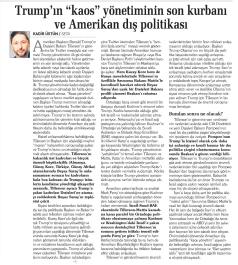
Trump’ın “kaos” yönetiminin son kurbanı ve Amerikan dış politikası

Bu yazı ilk olarak 17 Mart 2018 tarihinde Sabah‘ta yayınlanmıştır.

SABAH_20180317_15
Download PDF

Amerikan Başkanı Donald Trump’ın Dışişleri Bakanı Tillerson’ın görevine bir Twitter mesajıyla son vermesi Trump yönetiminin ilk gününden beri skandalları alışkanlık haline getirmesinin en son örneği oldu. Yönetimden istifa ederek veya kovularak ayrılanların listesi oldukça kabarık ancak Dışişleri Bakanı gibi kabinenin ağır toplarından birinin sosyal medyada kovulması bir ilk. Trump yönetiminde kadro değişikliği dedikodusunun olmadığı bir hafta olmadı desek abartı olmaz. “Kaos yönetimi” uygulayan ve bunu marifet sayarak övünen Başkan Trump memnun olmadığı kabine üyeleri hakkında Twitter’dan sert ve hatta aşağılayıcı mesaj atmaktan da çekinmiyor. Trump’ın bu tarzının aslında adı konmamış bir yönetim krizi olduğu ve önümüzdeki dönemde Amerikan dış politikasını daha da belirsizliğe sürükleyeceği söylenebilir.

Kişisel anlaşmazlıklarına bakıldığında Tillerson’ın Başkan için söylediği meşhur “moron” hakaretinin rol oynadığı aşikar ve Trump’ın bunu unutmadığını söylemek abartı olmayacaktır. Tillerson’ın bakanlık üst kadroları ve birçok önemli büyükelçilik (Almanya, Güney Kore, Türkiye, Güney Afrika) atamalarında Beyaz Saray’la anlaşamaması sonucu bu kadroların hala boş kalması da Trumpçı isimlerin kendisine yönelttiği şikayetler arasında. Tillerson ayrıca Trump’a yakın kadroları Dışişleri’ne atamayı reddederek Beyaz Saray’ın tepkisini çekti.

Siyasi tercihleri açısından bakıldığında ise dış politikada Başkan ve Bakan’ın adeta ayrı tellerden çalması neden gösterilebilir. Kuzey Kore‘yle ilgili olarak Trump’ın tansiyonu yükselttiği ve hatta nükleer savaş aşamasına gelindiği yorumları yapıldığı dönemde Tillerson eninde sonunda Kuzey Kore’yle doğrudan görüşmek zorunda olduklarını ve müzakere kanallarının açık olduğu yorumlarını yapıyordu. Trump el yükseltmeye çalışırken Tillerson müzakere yollarını zorluyordu. Başkan rahatsızlığını yine Twitter üzerinden Tillerson’a “kendini fazla yorma” mesajı vererek göstermişti. Benzer biçimde Amerikan kamuoyu baskısına rağmen Rusya’yı veya Rus Devlet Başkanı Putin’i eleştirmekten kaçınan Trump’ın Tillerson’ın Moskova’ya karşı sert söyleminden rahatsız olduğu aşikar. Hem Kuzey Kore hem de Rusya meselelerinde Tillerson’ın özellikle Savunma Bakanı Mattis’le koordineli hareket ederek Beyaz Saray’dan uzak bir Dışişleri Bakanı profili çizmesi Başkan’ı rahatsız ediyordu.

Ortadoğu barış süreci gibi önemli bir dosyayı damadı Kushner’e emanet eden Trump, Kudüs kararında olduğu gibi tek taraflı ve maksimalist adımlar atmayı seviyor. Netanyahu’ya ve İsrail sağ pozisyonuna yakınlığı bilinen Kushner’in Ortadoğu’ya bakışında da Suudi Arabistan ve Birleşik Arap Emirlikleri (BAE) çizgisine yakın bir duruşu var. Bu iki ülkenin Katar’a uyguladığı ambargo karşısında Washington’da birbirine zıt iki yaklaşım oluştu. Trump yönetiminin “yetişkinleri”ni temsil eden Tillerson ve Mattis, Katar’ın Amerikan müttefiki olduğunu ve terörle mücadelede yanlarında yer aldığını söylerken Trump Katar’ı teröre destek vermekle suçlamıştı. Körfez kriziyle birlikte Trump yönetimi içerisindeki ayrışma net bir biçimde ortaya çıkmıştı.

Amerikan askeri tarihçisi ve analisti Mark Perry’nin aktardığına göre Kushner Katar’a uygulanacak ambargodan önceden haberi olmasına rağmen Trump’a haber vermemişti. İsrail-Suud-BAE ekseninde Tillerson-Mattis kanadına karşı paralel bir Ortadoğu politikasıoluşturmaya çalışan Kushner ve Washington’daki İsrail’e yakın neocon destekçileri Tillerson’ın sonunu getiren ittifakı temsil ediyordu Perry’ye göre. Trump’ın hem Körfez krizinde takındığı tavra hem de Amerikan Büyükelçiliğini Kudüs’e taşıma kararına bakıldığında bu ittifakın fazlaca etkin olduğu anlaşılıyor.

Tillerson’ın gönderilmesinin önemli nedenlerinden birinin İran nükleer anlaşmasının olduğu anlaşılıyor. Başkan Trump Obama’nın en büyük dış politika başarılarından saydığı anlaşmayı iptal etmek için çok çaba sarf etti.
Anlaşma uluslararası nitelikte olduğu için tek taraflı iptal edemeyen Trump, İran’ın anlaşmaya uyduğunu kerhen onaylamak zorunda kalmış ancak en son onaylamayı reddederek topu Kongre’ye atmıştı.
Kampanya döneminde anlaşmayı yırtıp atma sözü veren ve özellikle Obama’nın siyasi mirasını yok etmeyi kendine misyon edinen Trump için Tillerson’ın bu konuda direnmesi de önemli rol oynamışa benziyor.

Bundan sonra ne olacak?

Tillerson’ın görevine son verilmesinin nedenleri aslında eski CIA Direktörü ve yeni Dışişleri Bakanı Pompeo’nun nasıl bir dış politika çizgisi izleyebileceğinin ipuçlarını da veriyor. Pompeo’nun Trump’la kişisel olarak çok daha iyi anlaştığı ve kendi başına bir dış politika çizgisi oluşturmama konusunda Başkan’a güven verdiği biliniyor.
Tillerson’ın Trump’ın önceliklerini göz ardı etmesi gönderilmesinin önemli nedenlerinden biri sayıldığı için Pompeo Başkan’dan bağımsız davranıyor görünmemeye özen gösterecektir. Bakanlık kadrolarına da bir an önce Trumpçı ve İsrail sağına yakın neocon isimleri ataması hiç de sürpriz olmayacaktır.

İran’a karşı daha sert bir politika izlemeyi savunduğu bilinen Pompeo’nun “makul şahin” Savunma Bakanı Mattis’le nasıl bir ilişki kuracağı önemli olacak.
Her iki isim de bölgede İran’ın etkisini azaltmak istiyor ancak Mattis hem Kore Yarımadası hem de Ortadoğu’da tansiyonu artıracak ve ABD’yi yeni bir askeri çatışmanın içine çekecek adımlardan kaçınan bir isim olarak öne çıkıyor.
Önümüzdeki dönemde Amerikan dış politikasında “kaos yönetimi” sayesinde belirsizliğin artması, İsrail sağına yakın neoconların öne çıkması ve “Ben yaptım oldu” tarzı tek taraflılığın ağırlık kazanması sürpriz olmayacak.

Some Myths about the YPG

This article was first published by New Turkey on March 13, 2018.

Abandoning the myths about the YPG would serve the US interests. Then comes the hard task of crafting a realistic Syria policy that is coordinated with Turkey and one that can achieve lasting stability.

Some Myths about the YPG

Ever since Turkey launched Operation Olive Branch in northwestern Syria, its goals have been mischaracterized and quite a few myths continue to thrive. One of these is that Turkey is conducting the operation because it cannot tolerate any “Kurdish” gains in northern Syria. It has become commonplace to describe the PKK-linked YPG as “American-backed Kurdish militias” or simply “Kurds” as if they represent the majority or all of Syrian Kurds. In fact, the YPG has sought to dominate the region at the expense of Kurdish groups not aligned with the PKK.

Back in the fall of 2014 during the battle for Kobani, the YPG refused to allow a large contingent of Peshmerga forces to help with the fight against Daesh. At the time, Turkey had even allowed the Kurdish Peshmerga forces from Iraq to travel through its territory – a first in Turkish history – to arrive in Kobani. From the beginning, the YPG has only been interested in creating a PKK stronghold in northern Syria. This is clearly unacceptable for Turkey but it is a far cry from an “obsession” with any Kurdish political gain in Syria. If anything, Turkey has encouraged unity among Syrian Kurds and sought to convince the PYD to join the opposition forces against Assad. Turkey also supported non-PYD Kurdish representation in a national dialogue congress.

Another major myth has been the YPG’s “effectiveness” as ground forces against Daesh. It should be remembered that the PYD had made a deal with the Assad regime at the beginning of the Syrian uprising. It was only after the sudden rise of Daesh that the YPG started to promote itself as “staunchly secular” and fearless fighters against Daesh. The Obama administration decided to utilize them as “local partners” against Daesh in an environment where the American public was opposed to any “boots on the ground.” Ever since then, the YPG has dominated the military battlefield largely thanks to US military supportincluding critical air cover and protection.

The devil’s bargain continued under the Trump administration but the YPG’s utility is now proving limited at best. The political commitment of the YPG to the PKK’s goals in Syria is so strong that they announced that they would redeploy their forces from the Daesh fight to Afrin against Turkey. The irony should not be escaping anyone that the YPG is willing to abandon the fight against Daesh – the very rationale for the US support – in order to fight a US NATO ally. Some analysts have suggested that the US can broker a deal with Turkey and somehow convince the YPG to sever ties with the PKK. However, Turkey’s Afrin operation has exposed that the congruity between the two is so deep and organic that the PKK’s strategic and political goals take priority over the fight against Daesh.

The myths about the YPG can be maintained so far as the US policymakers choose to ignore realities on the ground for political expediency or the lack of a coherent Syria policy. Turkey’s Afrin operation has already exposed many of the ill-conceived notions about the YPG. It is time for the US to coordinate with Turkey strategically and rely on its NATO ally for its policy goals. Establishing stability in northern Syria is a common goal but it cannot come at the expense of Turkey’s national security. Ensuring that Daesh does not come back is also a common goal but the YPG cannot be relied upon to achieve it. Abandoning the myths about the YPG would serve the US well. Then comes the hard task of crafting a realistic Syria policy that is coordinated with Turkey and one that can achieve lasting stability.

The US must end Support to the YPG to repair Ties with Turkey

This article was first published by New Turkey on March 6, 2018.

Recent visits by Trump administration officials have resulted in the creation of a strategic conversation mechanism but it is not clear how much progress can be made. After all, administration officials have not signaled a serious rethinking of the U.S. support for the YPG.

The US must end Support to the YPG to repair

The U.S. must end its military and political support to the YPG not only to repair ties with Turkey but also to bring long lasting stability to Syria. If the U.S. is interested in a semblance of stability in Syria, it is a no brainer that it needs to work with Turkey and not with the PKK’s Syrian branch. The YPG is a direct threat to Turkey’s national security and it is not a reliable insurer of stability in any meaningful sense of the word. It only makes sense for the U.S. the U.S. to work with its state allies like Turkey, not a terror group’s extension.

The PKK’s Syrian branch, the YPG, has sought to carve out an autonomous zone in northern Syria by securing U.S. support under the pretext of fighting Daesh and by kicking Arab populations out of their lands. The PKK utilized the rise of Daesh and secured this as an opportunity by promising the U.S. that it will fight the terrorist organization in return for military and political support. The Obama administration played along starting with the Kobani fight and bought into PKK’s game plan despite Turkey’s multiple warnings. However, starting with Operation Euphrates Shield, Turkey displayed its determination in terms that it will not tolerate the PKK’s efforts to create a statelet for itself with U.S. support.

While rebranding the PKK’s Syrian forces and integrating them into the Syrian Democratic Forces (SDF) may have looked like a clever move, it was simply a gimmick to evade Turkey’s reaction and avoid legal complications, as U.S. law does not permit providing support to terror organizations. By investing in a partnership with the YPG, the U.S. created a center of gravity around it, driving many smaller groups to be part of the SDF. The SDF might include many non-YPG fighters but the YPG has remained the dominant group accomplishing its military and political goals.

The already existing command structure owed to the PKK made it easier for U.S. planners to invest in the YPG and to promote them as the most “effective fighters.” In reality, though, their “success” against Daesh always entailed U.S. air cover and military support including heavy weaponry. If one of the central goals of U.S. policy is stability, a group that depends on U.S. support so much cannot deliver it.

The YPG systematically pushed Arab populations out from their lands in northern Syria, rendering them refugees in Turkey. The YPG was able to justify this demographic engineering under the pretext that many of these Sunni Arabs might have ties to Daesh. With the blessing and support of the U.S. forces, they are now the dominant force controlling Arab majority cities like Raqqa. U.S. policymakers must recognize the reality that the YPG they have invested in is a destabilizing factor itself. Turkey’s Afrin operation has shown that the YPG has its own political agenda and it is not only interested in fighting Daesh. Moreover, it is ready to make deals with all actors, including the Assad regime.

Turkey is out of patience. Multiple promises by the Obama and Trump administrations have proven to be empty rhetoric. Recent visits by Trump administration officials have resulted in the creation of a strategic conversation mechanism but it is not clear how much progress can be made. After all, administration officials have not signaled a serious rethinking of the U.S. support for the YPG. If the U.S. treats the discussions in this new mechanism as brainstorming sessions with no concrete action on the ground, they may prove to be futile. “Working through” Turkey’s concerns may not cut it this time around; a real strategic conversation needs to start addressing Turkey’s national security requirements.

The KRG’s Independence Bid Spells Trouble

This article was first published by New Turkey on Sebtember 27, 2017.

An independent Iraqi Kurdistan would probably lead to yet another round of conflict in Iraq’s never-ending civil war. In the absence of any international backing and legitimacy, the KRG leaders will need to think long and hard before declaring independence.

The KRG s Independence Bid Spells Trouble

The Kurdistan Regional Government’s (KRG) referendum on independence is no great news for an already fractured country and a destabilized region. Independence is an openly stated goal of the Iraqi Kurds who consistently declare it is only a question of when, not if. However, the only outside support for KRG independence is confined to the Israeli promise to recognize a potential Kurdish state. Most stakeholders, including the U.S. and Turkey, oppose the referendum and support Iraq’s territorial integrity. Iraq has monumental challenges ahead including terrorism, reconstruction, refugees and internally displaced persons, and regional proxy wars being fought in its territory. A potential declaration of independence would most likely exacerbate these problems and lead to further destabilization of the country.

Some analysts have argued that Turkey might be open to or even embrace a declaration of independence given its close ties with the KRG. Turkey’s reaction so far has been anything but. A recent RAND Corporation report argues that Turkey might be open to Iraqi Kurdish independence especially if the declaration is not sudden and comes after negotiations with the Baghdad government over the long term. The reality is that the referendum is unlikely to lead to a declaration of independence and the KRG will seek an amicable divorce through talks with Baghdad. The most recent agreement between Erbil and Baghdad to fight against ISIS was supported and brokered by the U.S. In the case of independence, however, there is no such common ground and there does not seem to exist any available U.S. or Turkish patronage.

Iraq is fractured and will remain so for the foreseeable future. Unaddressed grievances in the country will likely exacerbate political instability despite the most recent military defeat of ISIS in Mosul. The most important reason for the emergence of ISIS was the failure of the Iraqi political system that left Sunnis out of the political system. Even in the very unlikely scenario where the KRG successfully negotiates Kurdistan’s exit from Iraq, the lack of Sunni say in the matter will continue to destabilize the country and the broader region. An Iraqi Kurdish exit will also be tested by the struggle over disputed territories and the lack of a political agreement.

Turkey’s economic investments and security interests along with its political relations with the KRG make it a critical actor. However, Turkey-KRG relations are now deeply unsettled by what looks like the KDP leader Barzani’s bid to prevail over his rivals with the promise of an elusive independence. If Turkey had supported the independence referendum, the KRG would have overcome a major hurdle in terms of international legitimacy. However, from Turkey’s perspective, the independence bid is a deeply destabilizing move in an environment where, only a few months ago, ISIS held large swaths of Iraqi territory. Turkey has had close relations with the KRG but multiple statements by Turkish officials against the upcoming referendum illustrate the limits of Turkish support for the KRG. Turkish opposition to the breakup of Iraq is so strong that Turkey might take punitive steps, including imposing sanctions against the KRG.

Turkey’s argument against Iraqi Kurdistan’s independence is based on a variety of considerations. First, yet another chapter in the long Iraqi civil war would bring about another layer of instability to the region and adversely impact Turkish economic and security interests. Second, potential new conflict could open up space in Iraq for the PKK which has already gained ground in Syria due to the prolonged civil war and American support for the PYD. Third, Turkey continues to value its relationship with the rest of Iraq and is particularly invested in the fate of the Turkmen community. Fourth, unintended consequences of the breakup of Iraq promise a whole new set of complications that would threaten Turkey’s border security and might weaken its current influence in northern Iraq.

Turkey has enjoyed strong ties with the KRG leadership but it does not want to be the enabler of a breakup of Iraq. Turkey spent a lot of energy during the tenure of the former Iraqi Prime Minister Nuri al-Maliki to ensure Sunni inclusion in the Iraqi political system. In an environment where the Sunnis have virtually no say in the future of Iraq, Turkey would not want to contribute to their further alienation by midwifing an independent Iraqi Kurdistan. If the referendum leads to a new era of ethnic conflict, Turkey’s security and economic interests would be negatively, potentially empowering the PKK.

In many ways, the independence referendum has placed the horse before the cart, so to speak. There was already a referendum in 2005 with an overwhelming support for independence. Repeating a referendum with predictably similar results only indicates an effort to strengthen Barzani’s hand politically rather than a step in achieving “self-determination.” While the votes are yet to be tallied, Barzani has officially claimed victory in the referendum vote – an expected repeat of the 2005 referendum result. Yet, it is not entirely clear if this result will actually empower the KRG’s hand, as the Baghdad government has already ruled out negotiations labeling the referendum “illegal.”

The KRG President Barzani has called for negotiations with Baghdad for independence, however, the potential punitive measures and political alienation by Turkey and Iran may weaken the KRG’s hand in forcing such negotiations. In fact, Iran has already closed its border shared with northern Iraq and Turkey is mulling whether to close the border. The KRG’s referendum bid was clearly to prop up Barzani’s position against rival Kurdish parties who have been calling for a new presidential election. Having gone forward without the agreement and patronage of two neighboring powers, Iran and Turkey, the KRG has risked political isolation, not to mention potential for conflict.

Ever since the invasion of Iraq by the U.S., Iraq has gone through periods of crises and chaos with short periods of only “relative” calm. It is currently in a highly fragile state and the breakup of the country through the establishment of an independent Iraqi Kurdistan would probably lead to yet another round of conflict in Iraq’s never-ending civil war. In the absence of any international backing and legitimacy, the KRG leaders will need to think long and hard before declaring independence.